Kai Yosihura, his practice examines the “ aspect of several ‘things’ merely being there (coexistence) ” and attempts to present these trials as “ abstract prototypes ( = compositions ) ” .
He currently creates five series of objects: block prints ( “ Miyou No.~ ” ) , display shelves ( “ Shelf No.~” ) , photographs ( “ Photo No.~ ” ) , patterns ( “ Pattern No.~ ” ) , and architectural models ( “ Model No.~ ” ) . Through the works themselves, the structuring of spaces where works, other and objects (and actions) are placed, and their documentation, he aims to hypothesise space (= compositions). The space itself becomes the various ways of accessing different ‘things’ and the scales required for each thing to function as itself; this multiplicity of access is what it defines as publicness.
Regarding the exhibition and event “ それぞれの部屋、凝らしの細部・呼吸の熱 ” :
“ それぞれの部屋、凝らしの細部・呼吸の熱 ” is exhibition and event, held of an installation and performance in two adjacent old wooden houses in Kyoto, Japan.
In this event, five series of works were placed within these two adjacent houses [ 1 ] . Each session offered a two-part tour for five visitors, lasting approximately two hours — the first half in House-1, and the second half in House-2. House-1 is a space renovated by surveying and interpreting the building’s history and traces, composed of rooms where elements from various periods remain. House-2 is a space where leftover objects and traces of previous residents' lives ( such as duct tape covering the entire surface of the wall ) remained. In these spaces, where several individual trials and things (= the indivisuals’ scales) are intermingled, Kai placed works and structured several rooms by arranging or repositioning both brought-in objects and, objects (and actions) originally found at these houses.
In House-1, Kai provided a guide and distributed floor maps [ 2 ] including information about the building and the works. While his serving tea with using “ Tea Shelf ” [ 3 ] , he talked about the two houses and the five series of works. An invitation for this event [ 4 ] was distributed to visitors, who were asked to bring it with them. At the end of the viewing in House-1, he distributed the " concept paper " ( printed with a text about his practice ) [ 5 ] and produced a work made on-site using the invitation and soil under the house [ 6 ] , which were given to the visitors as souvenirs.
In House-2, the artist only unlocked the door, told a few things regarding the handling of the works and the fact that visitors may view the house by walking around freely, and then he left there. House-2, numerous traces left by former residents remain, such as duct tape pasted all over the wall and metal hooks installed throughout [ 7 ] . In addition to the works, he structured rooms such as the " Room of Density " [ 8 ] , where the positions of remained objects and the orientation of handrails were slightly changed, and the " Room of Quantity " [ 9 ] , which was set up with hygrometers and other objects. For the full documentation of this event here.
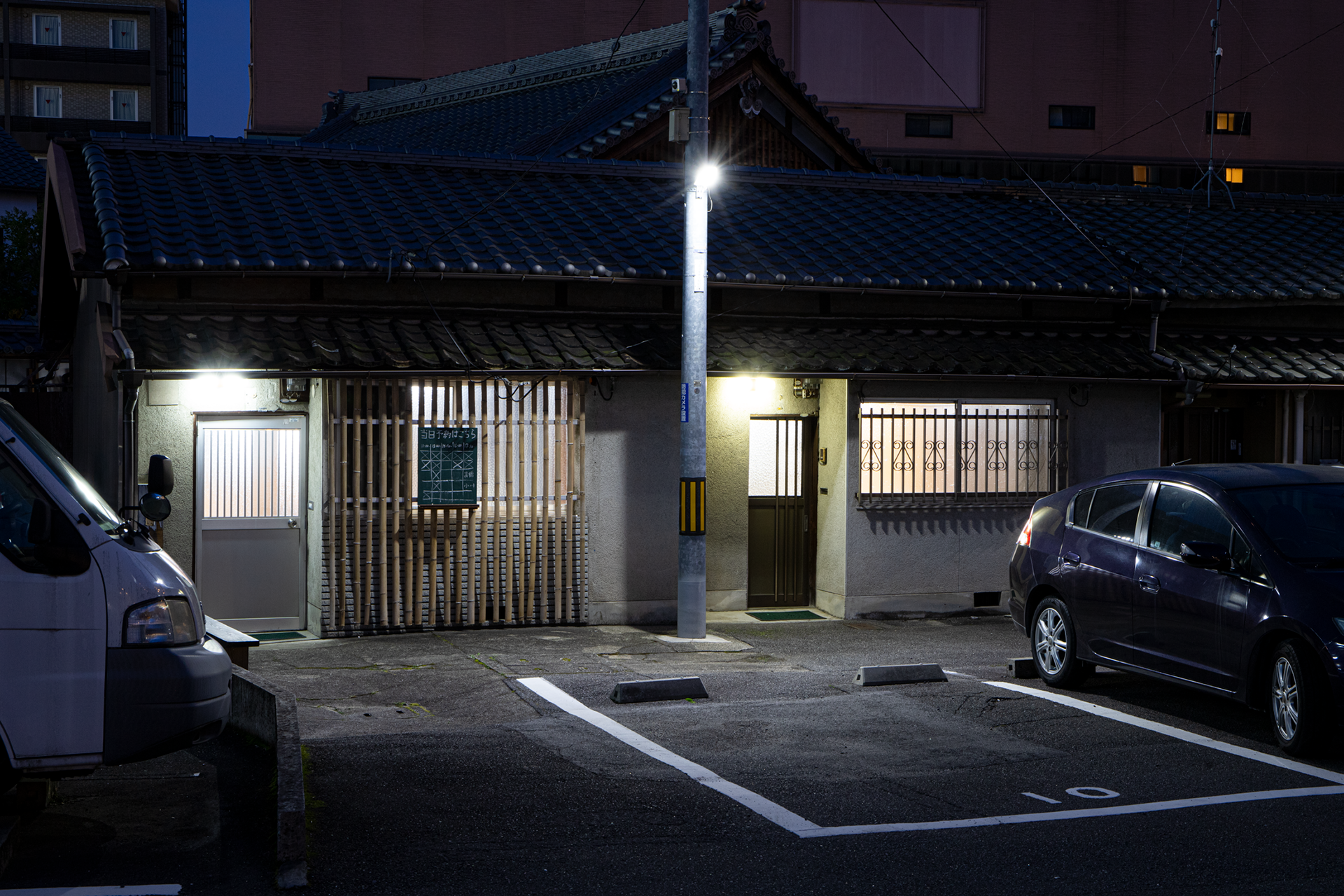
[ 1 ] Adjacent wooden houses in Kyoto, Japan / Left : House -1, Right: House-2
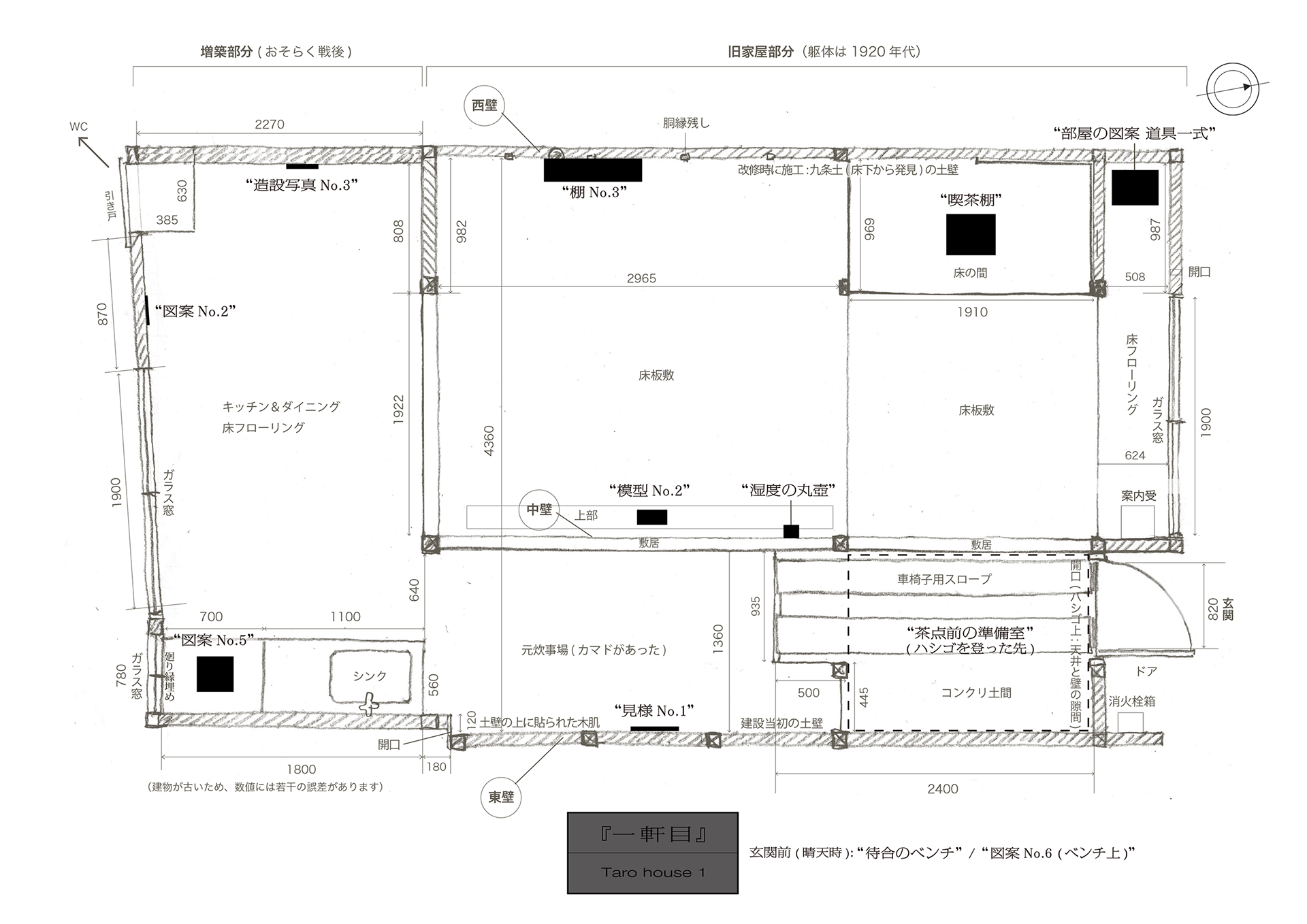
[ 2 ] A floor map − A map including architectual drawings and notes made during the survey for renovation of the houses by other people, with additional information regarding the placed works.
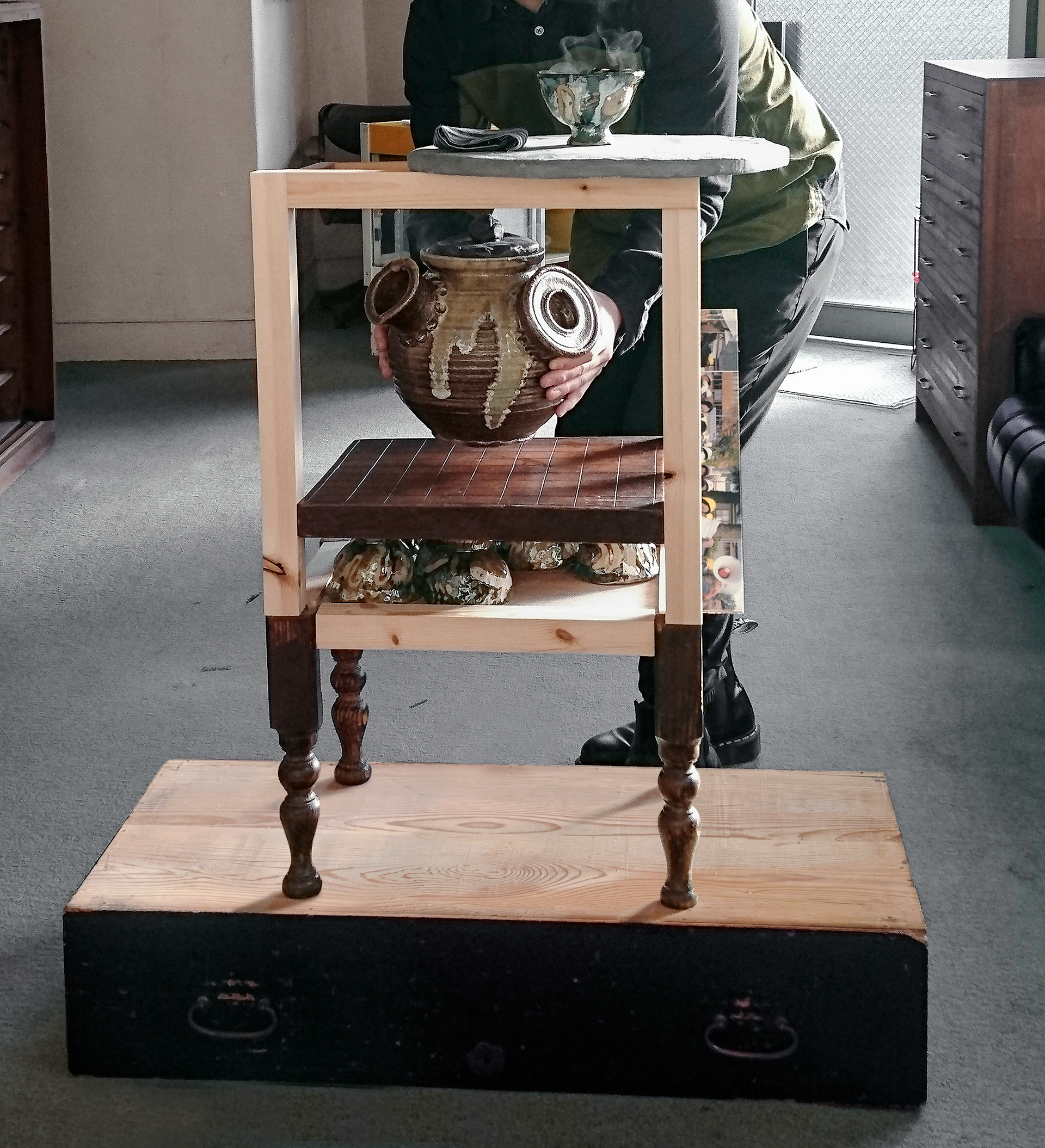
[ 3 ] “ Tea Shelf ” − This shelf work created for tea serving at a different event. While the actions of the tea serving are predetermined, the new ritual called “ humidity” was installed in the actions for this exhibition: at the beginning of the tea serving, water is dripped from a round jar to dampen the top board of the shelf.
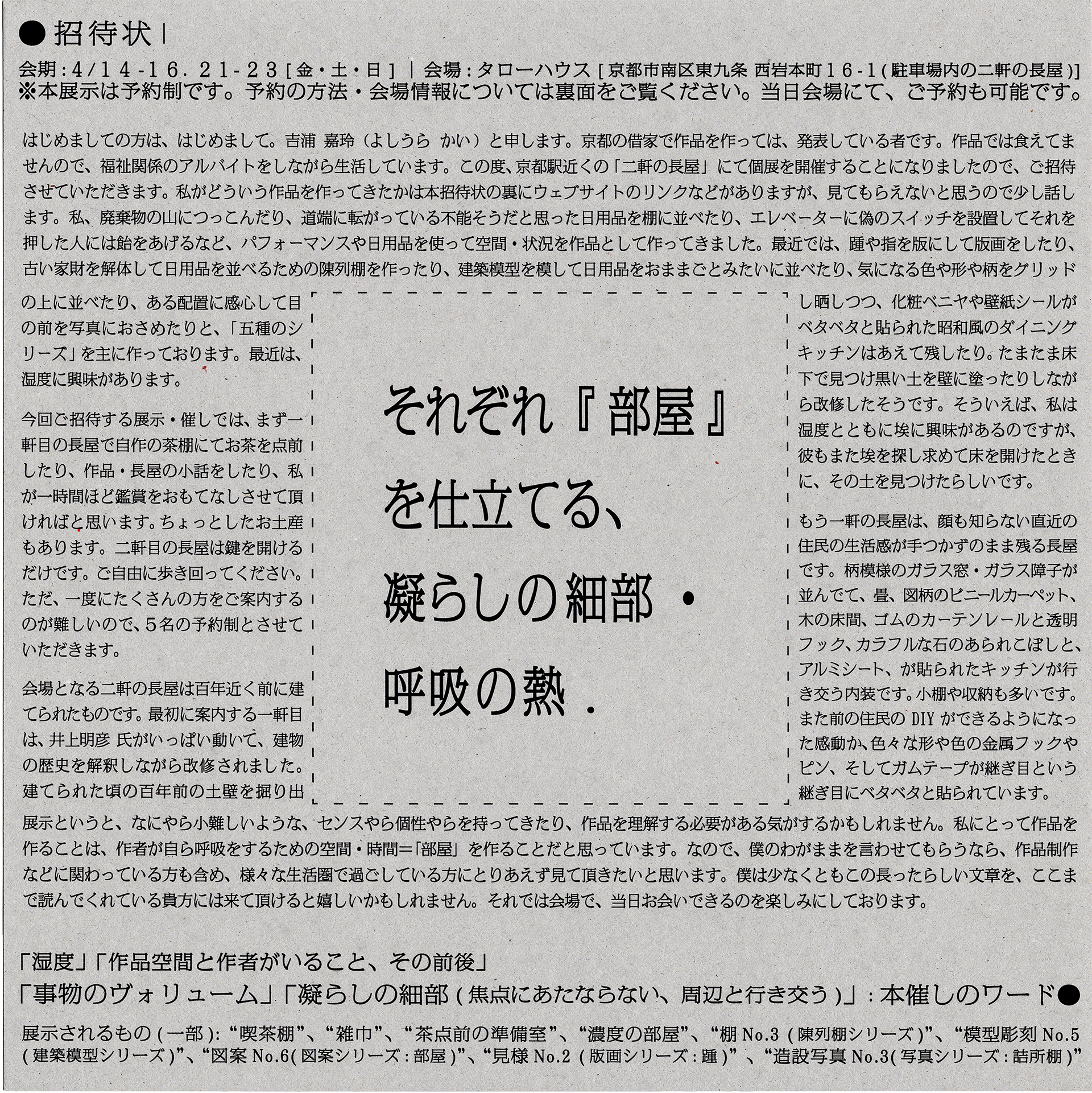
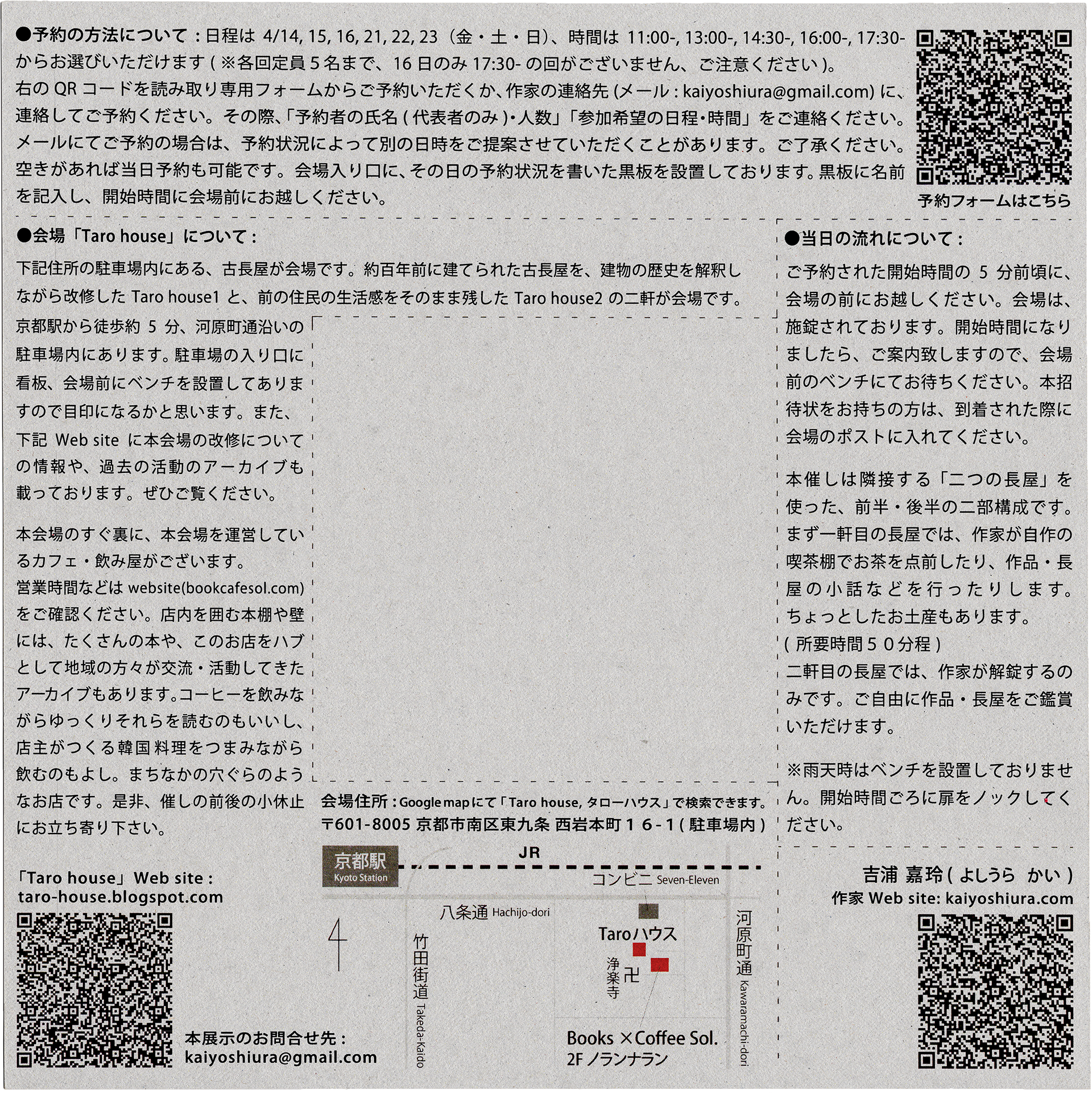
[ 4 ] Invitation − Visitors bring this when they visit, and it used as the material for the souvenir created at the end of the viewing in House -1 ( The back side was used ) . / Left : Front side, Right Back side.
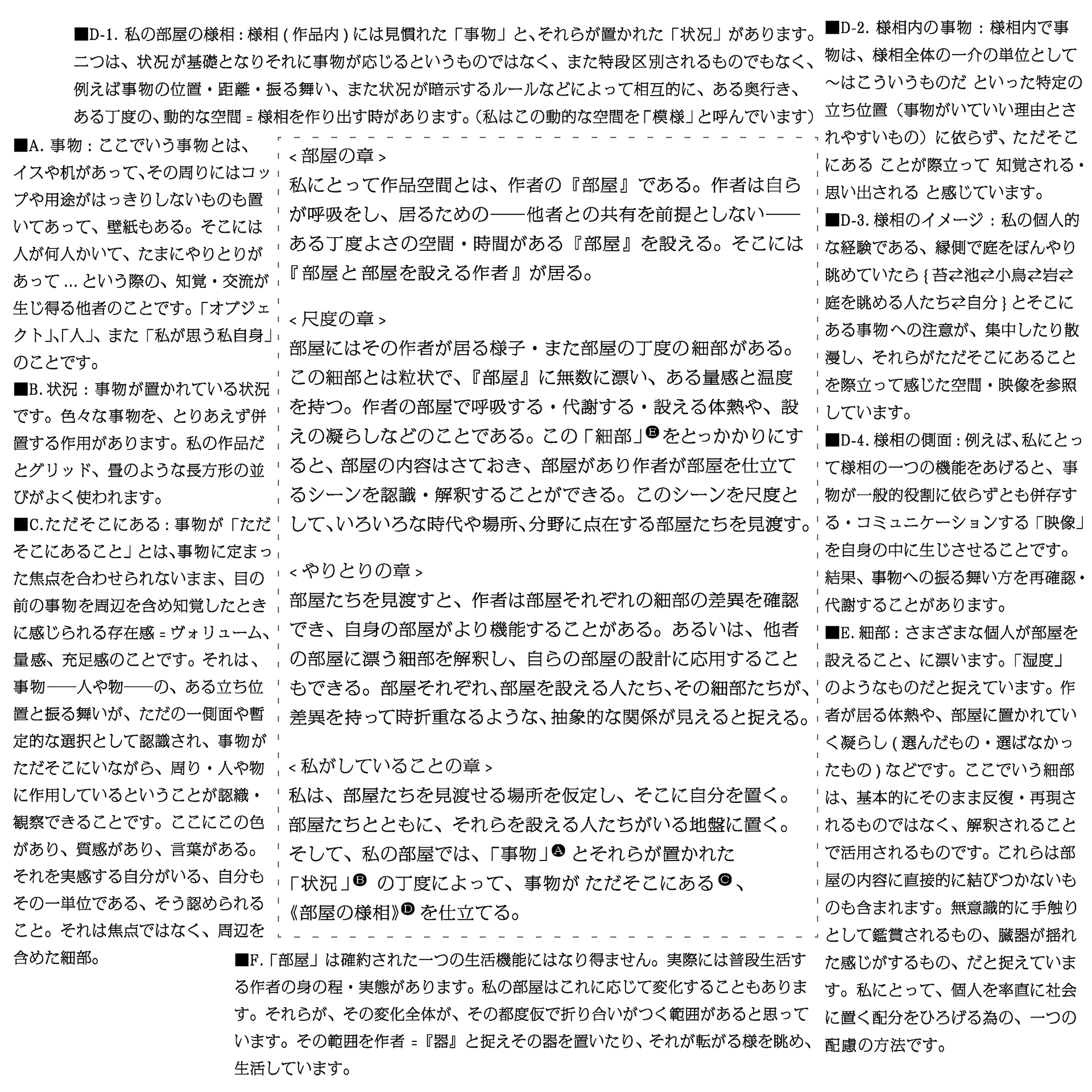
[ 5 ] “ concept paper ” − Given as a souvenir at the end of the viewing in House-1. A printed document regarding the artist’s practice — including “ the abstract prototypes (compositions)”, “ the aspect of things merely being there”, and the definition of Scales and Publicnes etc. It is continuously revised and distributed at exhibitions and events.
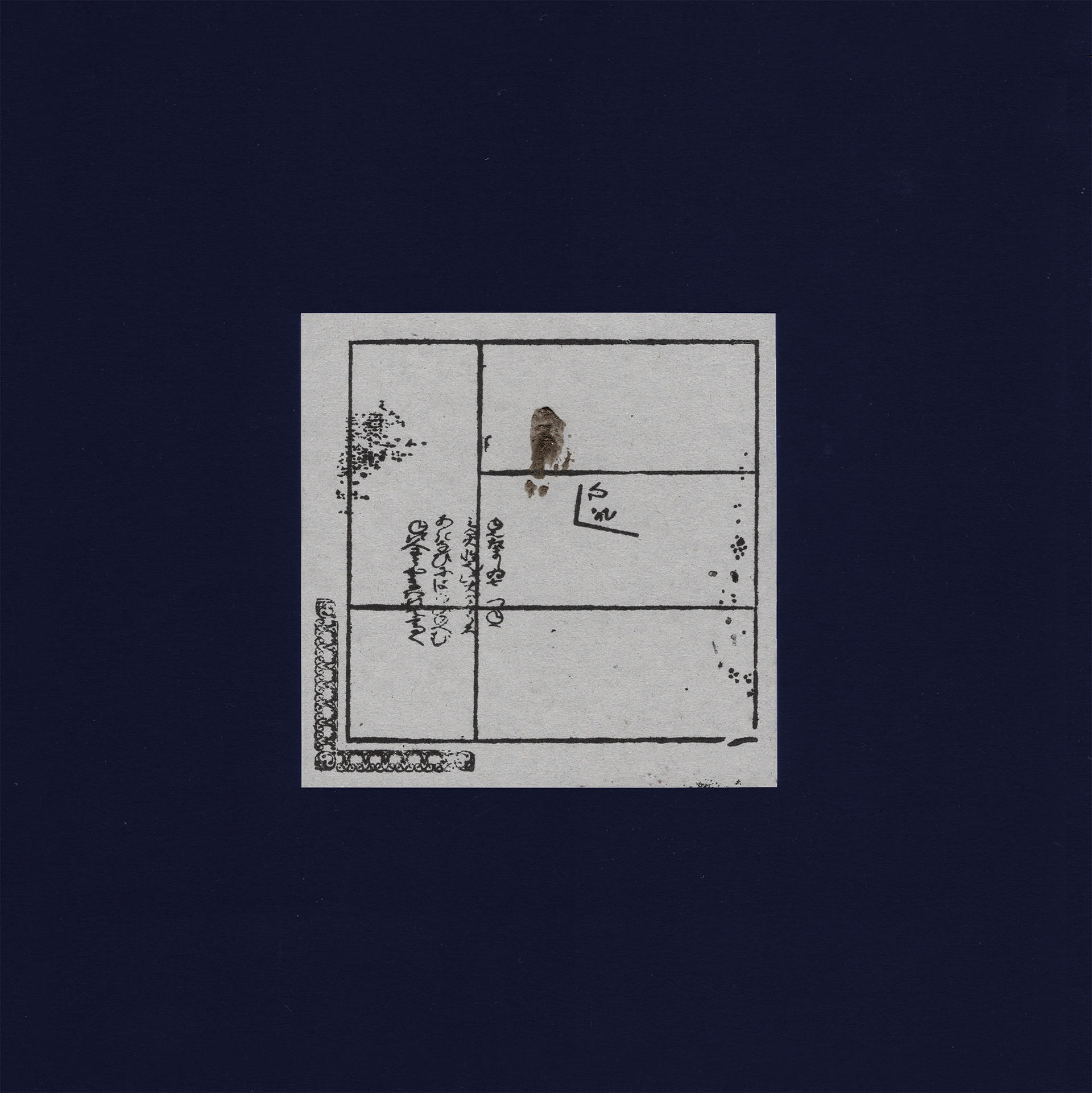
[ 6 ] “ Miyou No.3 ” − Given as a souvenir at the end of the viewing in House-1. The work was created on-site using the back side of the invitation, soil under House-1 ( applied the stamp using a finger knuckle ), a rubber block, and dots made with a bamboo pen. And a mount ( the blue area: removable ) was attached. This work is one of the block print series, “ Miyou No. -” .
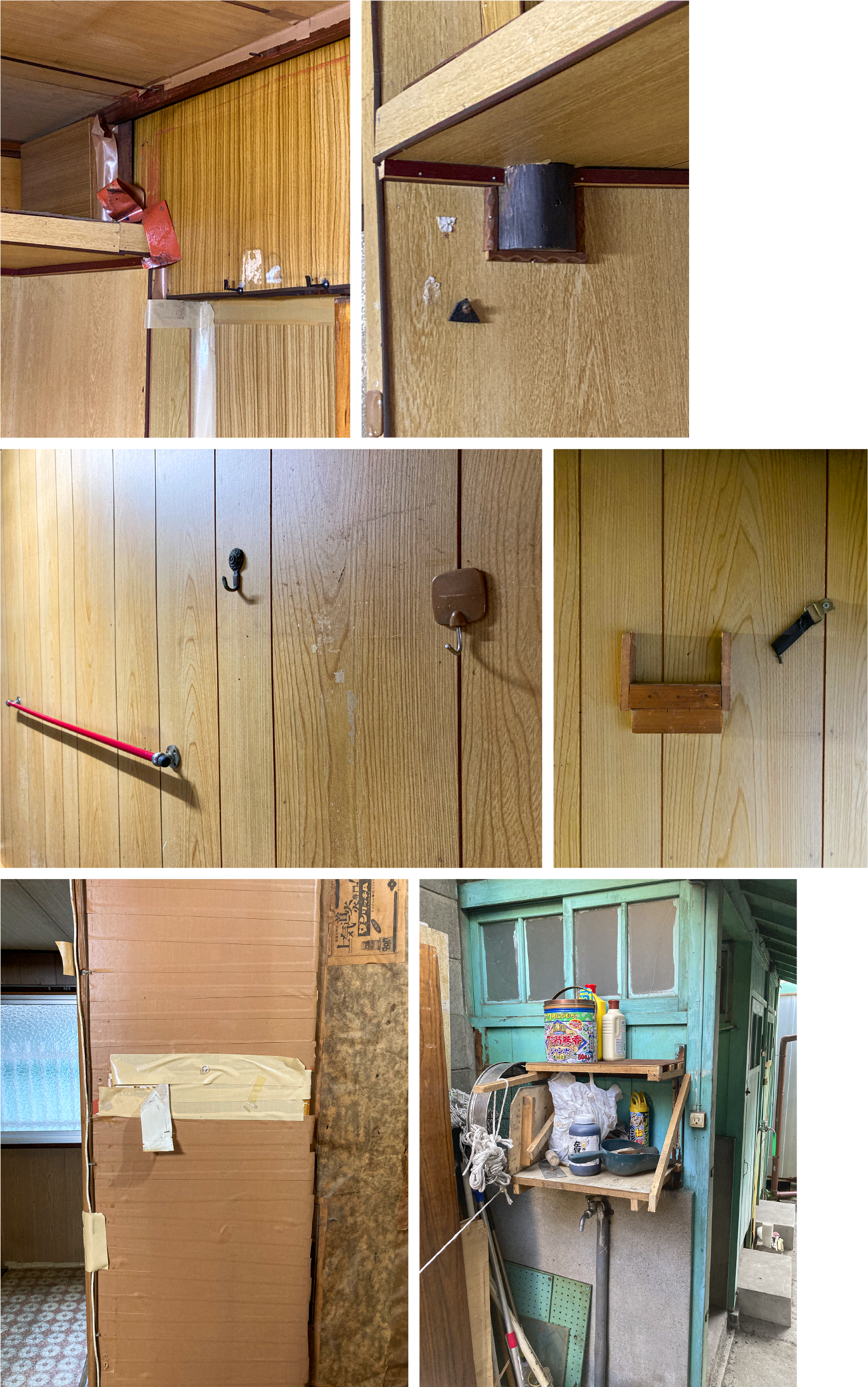
[ 7 ] Leftover objects and remained traces of previous residents' lives.
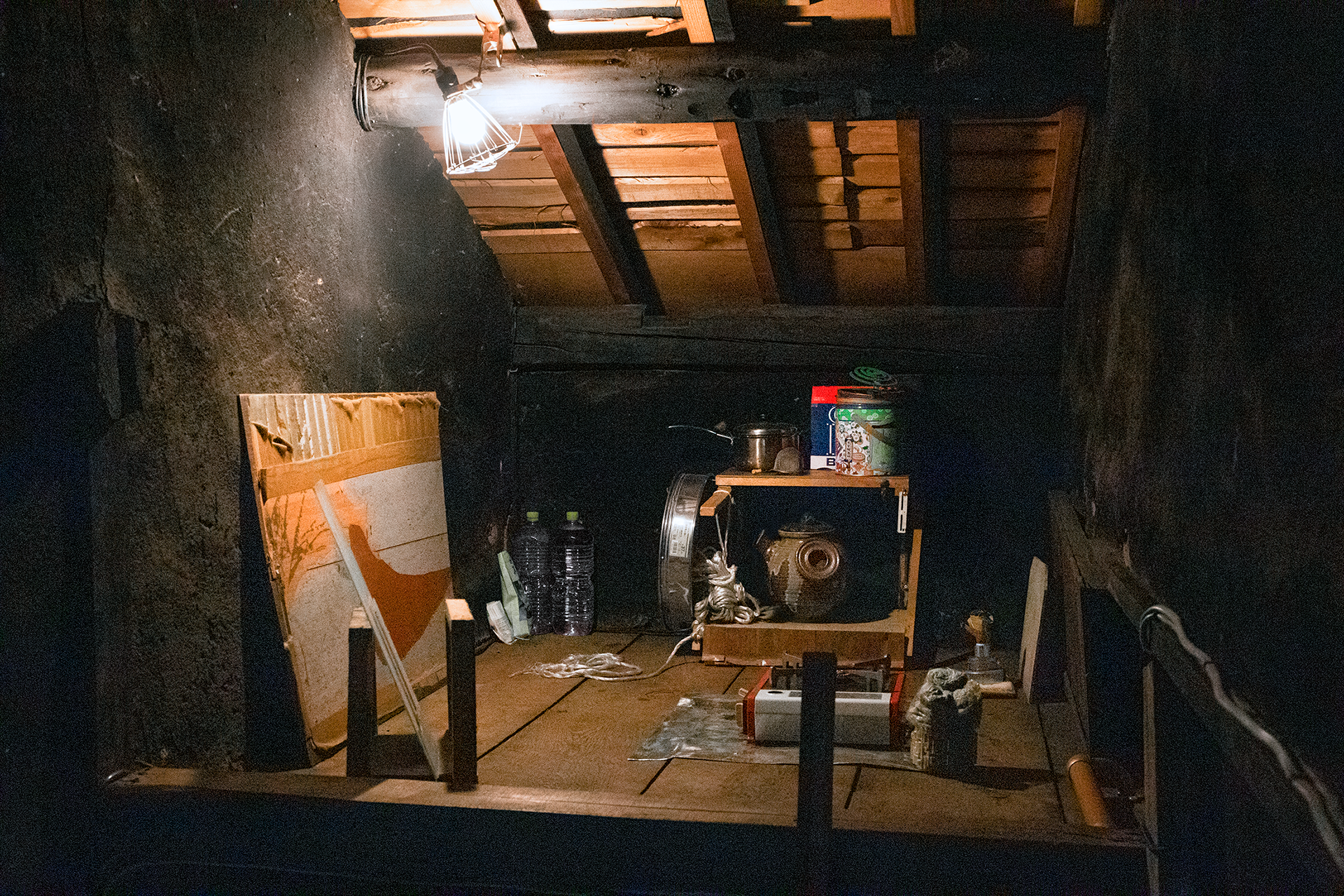
“ Preparation room for the tea serving ” in House-1 − A tool shelf located at the back of House-1 was relocated to the space above the entrance of House-1. After welcoming the visitors and speaking with them, the artist ascends to this room to prepare the tea serving, momentarily disappearing from their sight. Sounds of the preparation carry to the space below.
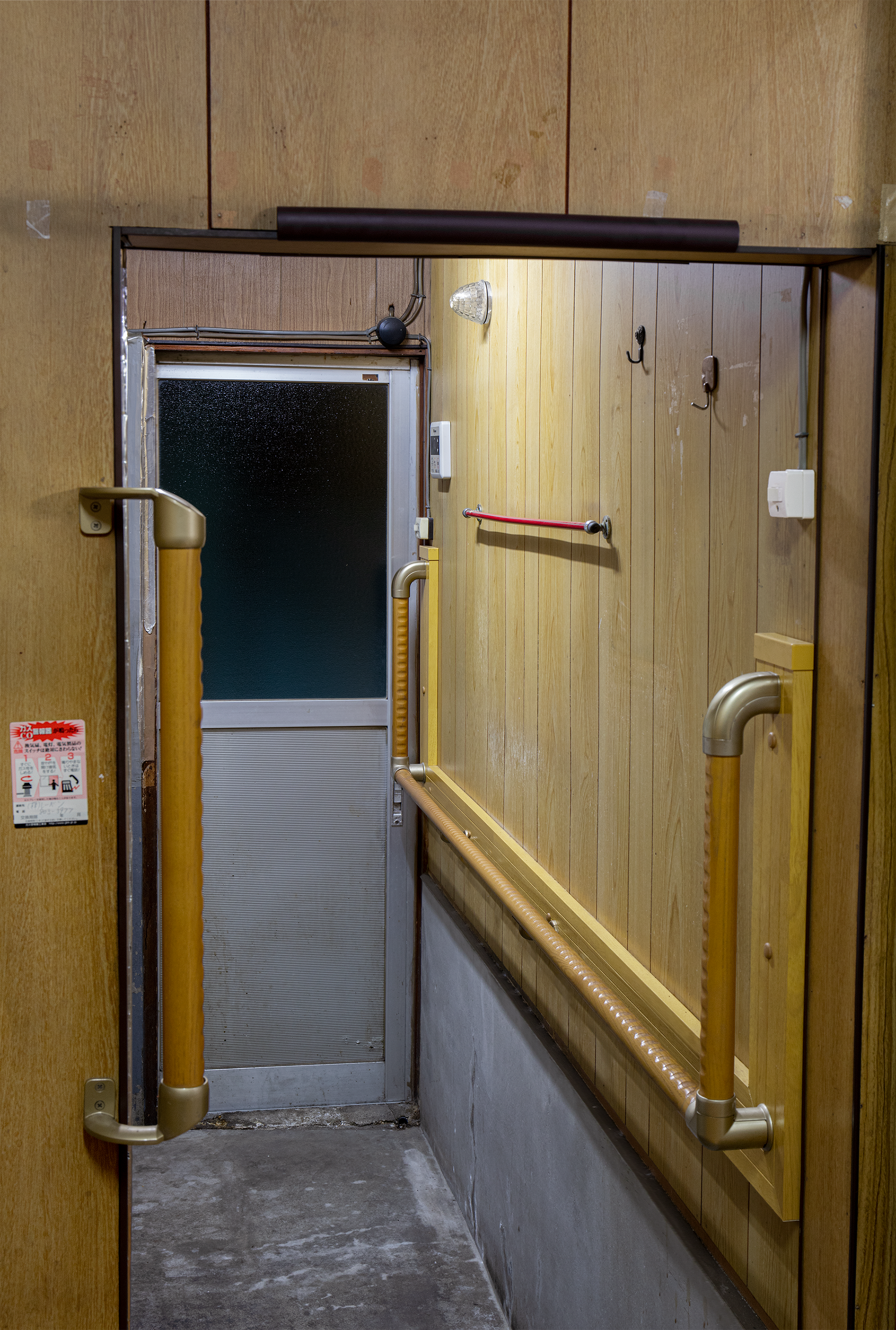
[ 8 ] “ Room of Density ” in House - 2 − An attempt to participate in the " individuals’ scales " of the residents by, for example, changing the orientation of handrails or subtly adding objects.
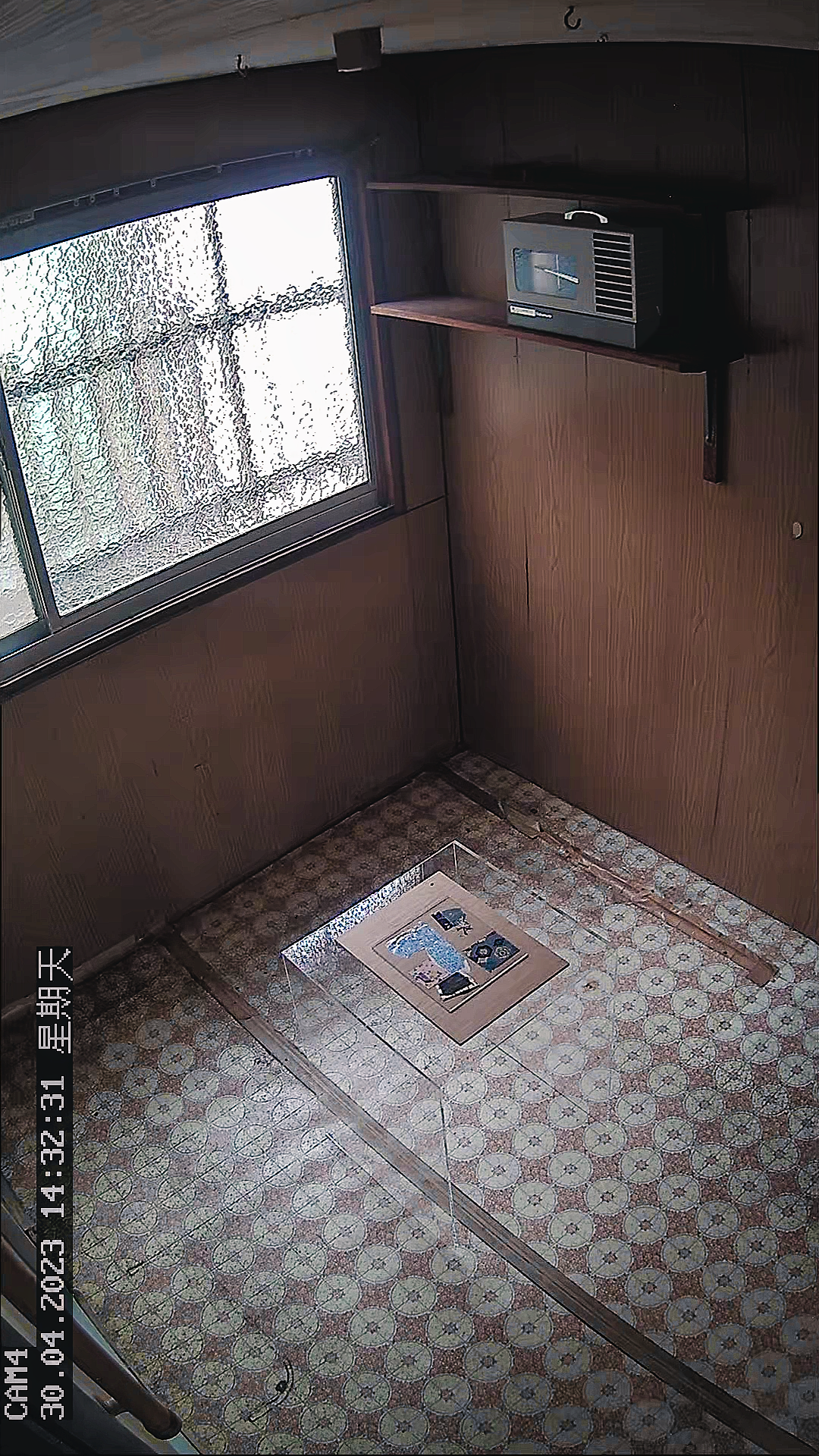
[ 9 ] “ Room of Quantity ” in House - 2 − “ Pattern No. 4 ” is placed in the center of the room. A hygrometer is placed on the shelf. It recorded the room’ s humidity and the vibrations of daily life from the neighbours through the walls.